What Age Is Ideal for 3D Mammogram Screening
March 7, 2026
Breast cancer screening has changed significantly over the past decade, especially with the increased use of 3D mammogram screening, also known as digital breast tomosynthesis. Many women now ask a common question: What age is ideal for a 3D mammogram?
The answer depends on medical guidelines, personal risk factors, and conversations with a healthcare provider. In this guide, we will explain recommended screening ages, how 3D mammography works, and how individual risk factors may change your timeline.
Understanding 3D Mammogram Screening
A 3D mammogram, also called digital breast tomosynthesis, is an advanced form of breast imaging used to detect breast cancer. Unlike traditional 2D mammography, which captures two flat images of the breast, 3D imaging takes multiple X-ray images from different angles. These images are combined to create a layered view of the breast tissue.
This layered approach helps radiologists examine dense breast tissue more clearly and reduces the chance of overlapping tissue hiding small tumors. Many medical organizations, including the American Cancer Society and the U.S. Preventive Services Task Force, recognize 3D mammography as an effective screening tool.
How 3D Mammography Improves Detection
Research shows that digital breast tomosynthesis can:
- Improve early breast cancer detection
- Reduce false positives
- Lower recall rates for additional imaging
- Provide clearer imaging for women with dense breasts
Early detection improves treatment options and outcomes. Screening mammograms are designed to find cancer before symptoms appear.
General Guidelines for Mammogram Screening Age
When talking about the ideal age for 3D mammogram screening, it is helpful to review national screening recommendations.
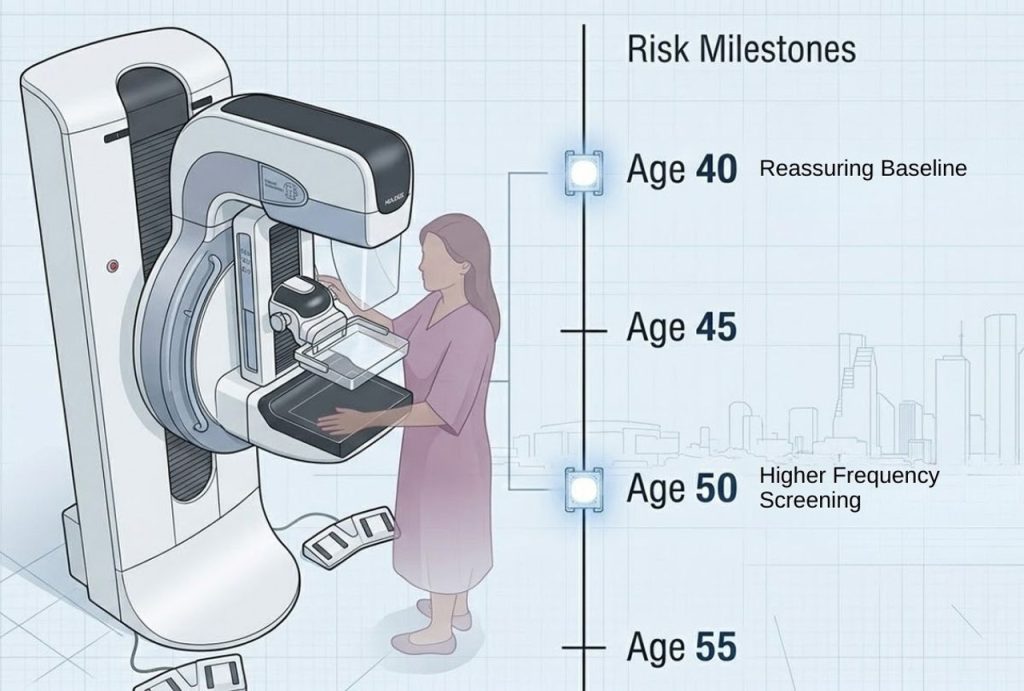
Starting at Age 40
The American College of Radiology and the Society of Breast Imaging recommend that women at average risk begin annual mammogram screening at age 40.
This recommendation is based on evidence that breast cancer risk increases in the 40s, and early detection can lead to more treatment options. For many women, age 40 is considered an appropriate time to start routine 3D mammography.
Ages 45 to 54
The American Cancer Society suggests that women may start annual screening at age 45, although beginning at 40 is an option. Between ages 45 and 54, annual mammograms are typically recommended.
This age group often benefits from yearly screening because breast cancer incidence increases during these years.
Age 55 and Older
After age 55, women may choose to continue annual screening or change to screening every two years, depending on personal health and physician guidance. Screening should continue as long as a woman is in good health and expected to live at least 10 more years.
Why Age 40 Is Often Considered Ideal
For women at average risk, age 40 is widely viewed as an appropriate starting point for 3D mammogram screening.
Here’s why:
- Breast cancer risk begins to increase in the early 40s.
- Early-stage cancers are more treatable.
- 3D mammography improves visualization in dense breast tissue, which is more common in younger women.
Women in their 40s often have denser breasts, which can make 2D mammograms harder to interpret. Digital breast tomosynthesis provides clearer layered images, improving detection rates.
When Earlier Screening May Be Recommended
While age 40 is standard for average-risk women, some individuals may need earlier screening.
Family History of Breast Cancer
If you have a first-degree relative (mother, sister, or daughter) diagnosed with breast cancer, your doctor may recommend starting screening earlier than 40.
Genetic Risk Factors
Women with known mutations in genes such as BRCA1 or BRCA2 may need earlier and more frequent screening. These patients may also undergo breast MRI in addition to mammography.
The National Comprehensive Cancer Network provides detailed screening guidelines for high-risk individuals.
Personal History of Breast Conditions
Women with a history of atypical hyperplasia, prior chest radiation therapy, or previous breast cancer may follow a customized screening schedule.
In these cases, age alone does not determine the ideal time for 3D mammogram screening. Risk assessment plays a larger role.
The Role of Dense Breast Tissue
Dense breast tissue is common and not abnormal. However, it can make cancer detection more challenging because both dense tissue and tumors appear white on a 2D mammogram.
Digital breast tomosynthesis offers clearer imaging in dense breasts. Many states require patients to be informed if they have dense breast tissue.
If you have been told you have dense breasts, your healthcare provider may recommend 3D mammogram screening as your primary screening tool starting at age 40.
How Often Should You Get a 3D Mammogram?
Screening frequency depends on age and risk factors.
- Ages 40–54: Annual screening is often recommended.
- Age 55 and older: Annual or biennial screening may be appropriate.
- High-risk individuals: May require annual screening starting earlier, sometimes with additional imaging such as MRI.
Regular screening allows radiologists to compare images year to year, helping identify subtle changes in breast tissue.
Benefits of 3D Mammogram Screening
Choosing 3D mammography provides several measurable advantages:
Improved Cancer Detection Rates
Studies show digital breast tomosynthesis can detect more invasive cancers compared to 2D mammography alone.
Fewer False Positives
False positives can cause stress and additional imaging. 3D mammograms reduce the likelihood of unnecessary callbacks.
Better Imaging for Younger Women
Since younger women often have denser breast tissue, 3D screening can provide clearer visualization, supporting early detection.
Potential Concerns and Safety
Some patients ask about radiation exposure. A 3D mammogram uses slightly more radiation than a traditional 2D mammogram, but the dose remains within safe FDA-approved limits.
In many modern systems, 2D images are reconstructed from 3D data, which helps keep radiation exposure comparable to standard mammography.
The benefits of early cancer detection generally outweigh the small radiation risk for women in the recommended screening age groups.
Individualized Screening Decisions
While guidelines provide general direction, the ideal age for 3D mammogram screening is not the same for every woman.
You should discuss:
- Personal medical history
- Family history
- Genetic risk
- Breast density
- Overall health status
Shared decision-making with your healthcare provider helps create a screening plan tailored to your needs.
Screening After Age 70
There is no fixed upper age limit for mammogram screening. Screening should continue as long as a woman is in good health and would pursue treatment if cancer were detected.
Life expectancy and overall health matter more than age alone. Many healthy women in their 70s and beyond continue to benefit from routine 3D mammography.
What to Expect During a 3D Mammogram
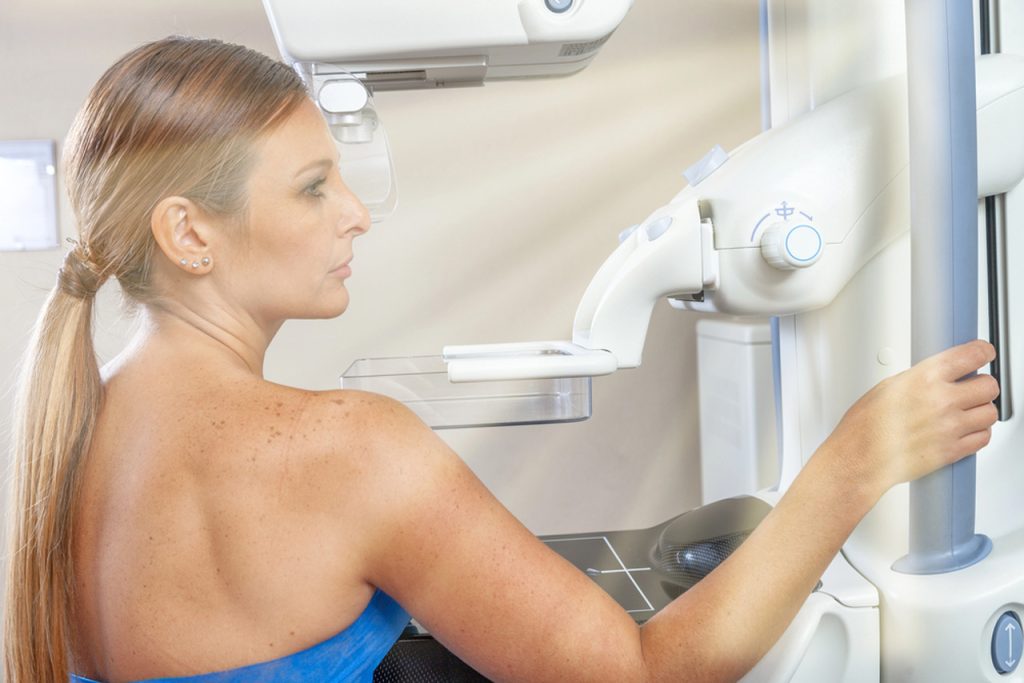
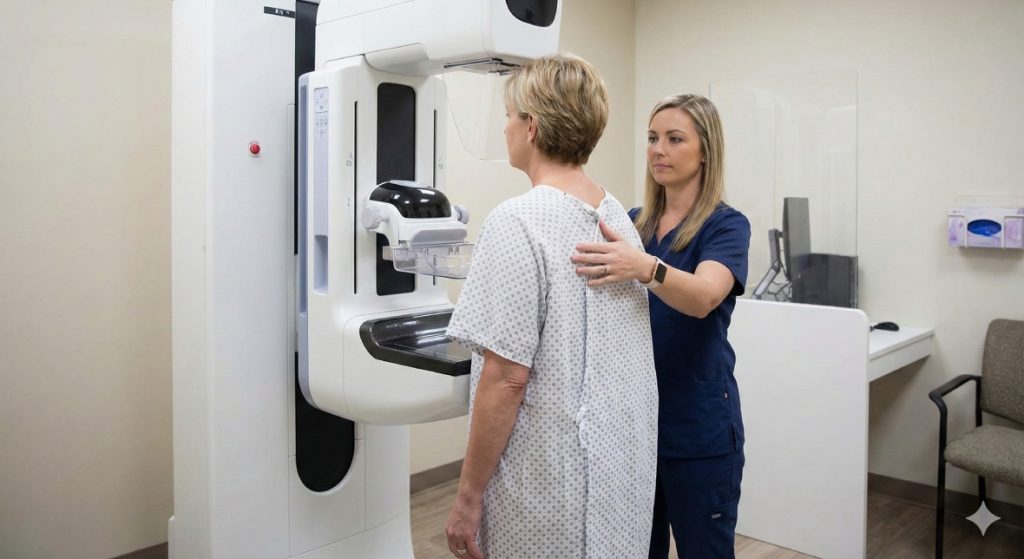
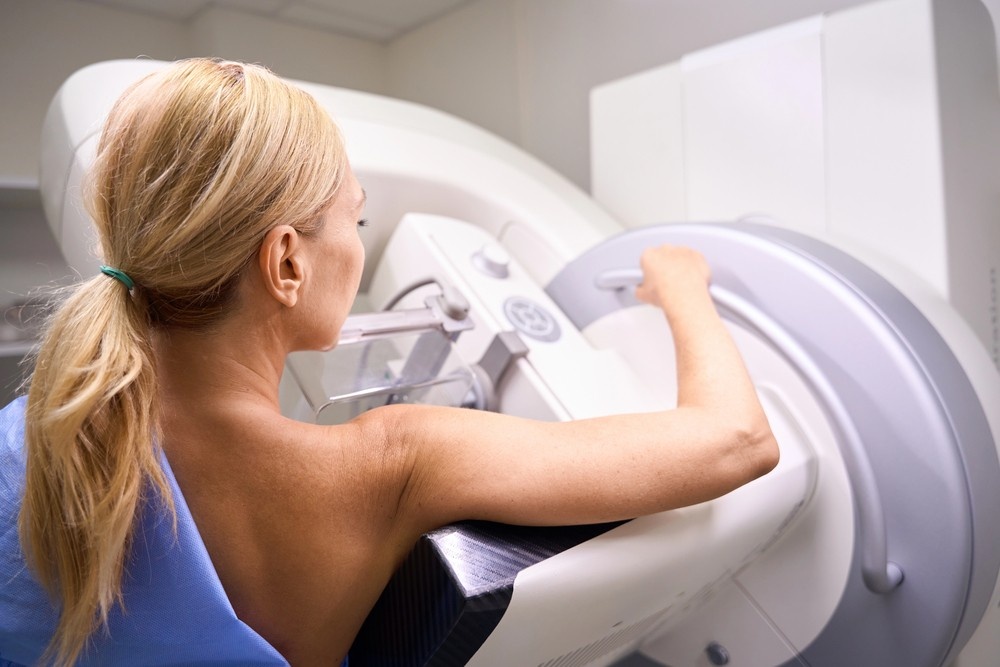
The procedure is similar to a traditional mammogram:
- The breast is positioned on a flat surface.
- Gentle compression is applied.
- The machine moves in an arc to capture multiple images.
The entire appointment typically takes about 20 minutes. Discomfort is usually brief and manageable.
At NextGen Diagnostic Imaging, advanced digital breast tomosynthesis technology is used to provide high-quality imaging while maintaining patient comfort and efficiency.
Why Early and Consistent Screening Matters
Breast cancer often develops without noticeable symptoms in early stages. Screening mammograms detect abnormalities before they can be felt.
When breast cancer is found early:
- Treatment options are often less aggressive
- Survival rates are higher
- Recovery may be faster
Age 40 is commonly recommended because it balances increasing risk with the benefit of early detection. However, high-risk individuals may begin earlier, and older women may continue screening based on health status.
Clear Imaging. Confident Decisions. Choose NextGen Diagnostic Imaging for 3D Mammograms in Gulfton
When it comes to breast cancer screening, accuracy and comfort both matter. At NextGen Diagnostic Imaging, we provide advanced 3D mammograms in Houston, proudly serving patients in the Gulfton neighborhood with modern technology, experienced radiology professionals, and a patient-centered approach.
If you live in or near Gulfton and are looking for reliable breast imaging, here’s why many women choose us for their 3D mammogram screening.
Advanced 3D Mammography Technology
We use digital breast tomosynthesis, commonly known as a 3D mammogram. Unlike traditional 2D imaging, this technology captures multiple images of the breast from different angles and creates detailed layered views.
Why This Matters
- Improved cancer detection rates
- Clearer imaging for dense breast tissue
- Fewer false positives
- Reduced call-backs for additional testing
Many women in their 40s and 50s have dense breast tissue. 3D mammography allows radiologists to examine tissue layer by layer, improving accuracy and helping detect abnormalities earlier.
At NextGen Diagnostic Imaging, our goal is simple: provide clear results that support confident medical decisions.
Convenient Access for Gulfton Residents
Living in Gulfton means you are part of one of Houston’s most diverse and active communities. We understand that convenience matters when scheduling healthcare appointments.
Our location makes it easier for patients in Gulfton and surrounding Houston neighborhoods to access high-quality 3D mammogram screening without traveling far across the city.
Flexible scheduling options help accommodate busy workdays, family responsibilities, and personal commitments. We aim to make breast cancer screening straightforward and accessible.
Experienced Radiology Team
Technology is important, but so is the expertise behind it.
Our imaging studies are interpreted by experienced radiology professionals trained in breast imaging and digital breast tomosynthesis. Accurate reading of mammogram results requires skill, precision, and attention to detail.
When you choose NextGen Diagnostic Imaging for your 3D mammogram in Houston, you can feel confident that your images are reviewed carefully and professionally.
Focused on Patient Comfort
It is normal to feel some anxiety before a mammogram appointment. Our team works to create a calm, respectful, and supportive environment from check-in to completion.
We focus on:
- Clear communication about the procedure
- Efficient appointment flow
- Gentle positioning techniques
- Respect for privacy
A 3D mammogram typically takes about 15 to 20 minutes. Compression is brief and necessary for accurate imaging, but our technologists are trained to keep you as comfortable as possible.
Early Detection Matters
Routine breast cancer screening plays an important role in early detection. Detecting cancer at an early stage often provides more treatment options and improved outcomes.
Women at average risk are commonly advised to begin mammogram screening at age 40. However, those with family history or other risk factors may need earlier screening.
If you live in Gulfton and are approaching your recommended screening age, choosing a facility that uses 3D mammography can provide additional clarity in imaging.
Clear Communication of Results
Understanding your results is just as important as obtaining accurate images. We ensure that reports are delivered promptly and clearly, helping you and your healthcare provider plan the next steps if needed.
Our team is committed to transparency and professionalism at every stage of the process.
Serving Houston with Modern Diagnostic Imaging
Houston is known for its strong healthcare network, and residents of Gulfton deserve access to advanced screening options close to home.
At NextGen Diagnostic Imaging, we combine:
- Modern 3D mammogram technology
- Skilled radiology interpretation
- Convenient Houston access
- A patient-focused experience
We believe breast imaging should be accurate, efficient, and supportive—not complicated.
Schedule Your 3D Mammogram near Gulfton Today
If you are searching for 3D mammograms in Houston near Gulfton, NextGen Diagnostic Imaging is here to provide professional, high-quality breast cancer screening in a comfortable environment.
Taking the next step in routine breast health screening is a practical and informed decision. Our team is ready to support you with advanced imaging and dependable care—right here in the Gulfton community.
NextGen Diagnostic Imaging Serving the Gulfton Community and Beyond in Houston
NextGen Diagnostic Imaging is dedicated to serving the diverse needs of the local community of Houston, including individuals residing in neighborhoods like Gulfton. With its convenient location near landmarks such as Benavidez Elementary School and major intersections like Gulfton St. and Westward St. (coordinates: 29.716704099999987, -95.4938099), we offer 3D mammograms Houston services.
Get 3D Mammogram Services in Gulfton Now
Navigate from Gulfton to NextGen Diagnostic Imaging Now
Final Thoughts
For women at average risk, age 40 is widely considered the ideal starting point for 3D mammogram screening.
However, the best answer depends on personal risk factors, medical history, and physician guidance. National organizations such as the American Cancer Society and the American College of Radiology provide screening guidelines, but individualized care remains important.
If you are approaching age 40, have a family history of breast cancer, or are unsure about your risk level, speaking with a healthcare provider can help clarify your screening plan.
Regular 3D mammogram screening is a proactive step in breast health management. With modern imaging technology available at NextGen Diagnostic Imaging, patients can access advanced screening designed to improve early detection and support informed healthcare decisions.
FAQs
1. What age should I start getting a 3D mammogram?
For women at average risk of breast cancer, most medical organizations recommend starting screening at age 40. Beginning at this age allows for earlier detection as breast cancer risk increases in the 40s. However, women with higher risk factors may need to start earlier based on physician guidance.
2. Is a 3D mammogram better than a traditional 2D mammogram?
A 3D mammogram (digital breast tomosynthesis) provides layered images of breast tissue, which can improve cancer detection and reduce false positives compared to standard 2D mammography. It is especially helpful for women with dense breast tissue because it allows radiologists to examine tissue more clearly.
3. Should women with dense breasts begin screening earlier?
Not always. Dense breast tissue does not automatically mean earlier screening, but it may influence the type of imaging recommended. Many providers suggest 3D mammography starting at age 40 for women with dense breasts because it improves image clarity and detection accuracy.
4. How often should I get a 3D mammogram after age 40?
Most guidelines suggest annual screening between ages 40 and 54. After age 55, women may continue yearly screening or change to screening every two years, depending on overall health and physician recommendations.
5. Can I continue 3D mammogram screening after age 70?
Yes. There is no strict upper age limit for mammogram screening. Women should continue screening as long as they are in good health and would pursue treatment if breast cancer were detected. Decisions after age 70 are usually based on overall health rather than age alone.

NextGen Scan
How X-Ray Services Help Doctors Make Fast Diagnoses
In healthcare, timing can be the difference between a minor concern and a major medical emergency. When symptoms appear—whether it’s sudden pain, shortness of breath, or an unexplained injury—doctors need answers quickly. This is where X-ray services step in as one of the most powerful diagnostic tools in modern medicine. For patients seeking X-ray services…What Are Mammogram Services And What Do They Include?
When it comes to protecting your long-term health, few screenings are as powerful—or as misunderstood—as a mammogram. Mammogram services are not just routine medical appointments; they are proactive tools that help detect breast changes long before symptoms appear. For women in Houston and Shenandoah, access to high-quality mammogram services can mean the difference between early…What Makes an Ultrasound Affordable Without Sacrificing Accuracy?
When patients hear that an ultrasound is “affordable,” the word often triggers doubt. In a healthcare system where prices vary wildly, many people assume lower cost must mean lower quality. After all, we’ve been trained to believe that better care always costs more. But diagnostic imaging doesn’t work that way. Ultrasound accuracy isn’t determined by…

Contact Us: We’re Here to Help!
We’d love to hear from you! Whether you have questions about our services, need more information on our diagnostic and pain management options, or would like to schedule an appointment, our friendly and professional team is here to assist you every step of the way. We are dedicated to providing you with the best care and support, and we are happy to address any concerns or inquiries you may have.